Eclectus Parrot Care Guide: Housing, Routine & Living With a Zen Bird
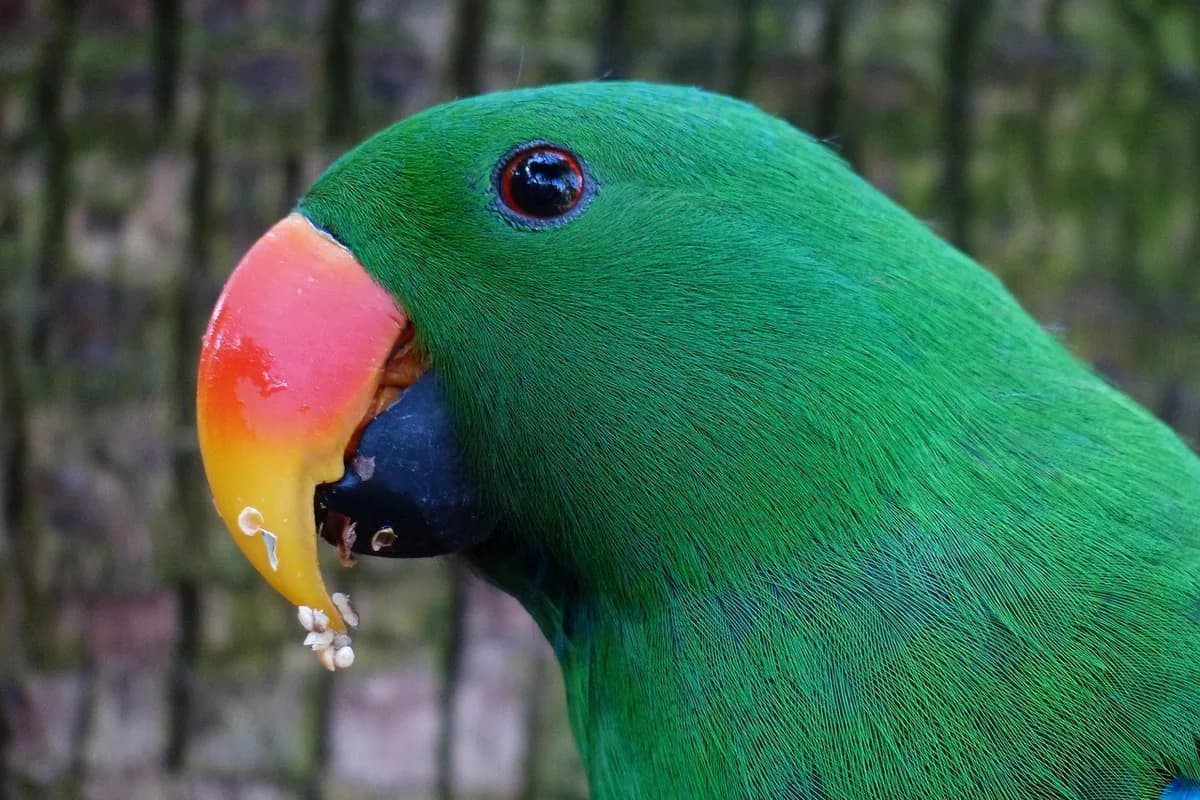
Few parrots make a first impression like the Eclectus. The male is a vivid, almost artificial-looking emerald green; the female is a deep crimson washed with royal blue and purple. The two look so different that early naturalists catalogued them as separate species. Beyond the colour, though, is a bird with an unusually steady, watchful temperament and one of the most delicate digestive systems in aviculture. At Bird Sitting Toronto, where we board hundreds of parrots a year, the Eclectus is the species whose owners ask us the most detailed questions about food — and rightly so.
This guide is the hub. It covers who the Eclectus is, how to house one, and what a day of good care looks like, then points you to our deeper articles on diet, health, behaviour, and training.
Is an Eclectus Right for You?
The Eclectus (Eclectus roratus) hails from the Solomon Islands, New Guinea, and the tip of northeastern Australia. It is a medium-large parrot, roughly 35 cm (14 in) long and weighing 375 to 550 g depending on subspecies and sex. Expect a companion for the long haul: a well-cared-for Eclectus lives 30 to 50 years.
Temperamentally, this is the "zen" parrot. Eclectus tend to be calm, gentle, and remarkably observant — they watch a room before they act. Their noise level is moderate for a parrot of this size (about a 3 out of 5); they are not constant screamers like some cockatoos or conures, though they do have loud contact calls and can be surprisingly good talkers (a 4 out of 5 for speech clarity).
Tip: The Eclectus rewards a quiet, consistent household. They are emotionally sensitive and pick up on tension between family members. If your home is chaotic or your schedule wildly unpredictable, a hardier, more forgiving species may be a kinder match.
This is an advanced-level bird — not because they are aggressive, but because their care is exacting. The single biggest reason is diet, which is genuinely different from every other parrot on this site. Read our diet and nutrition guide before you ever bring one home.
Housing Your Eclectus
Eclectus are active flyers with long, broad wings, and they need horizontal room to move.
| Feature | Recommendation |
|---|---|
| Minimum cage size | 90 x 90 x 120 cm (36 x 36 x 48 in) — bigger is always better |
| Bar spacing | 1.9 to 2.5 cm (3/4 to 1 in) |
| Cage shape | Rectangular with a flat or play-top; never round |
| Bar orientation | Some horizontal bars for climbing |
| Placement | A social room, against a wall, out of the kitchen |
Choose the largest cage your space allows. The dimensions above are a floor, not a target — an Eclectus that spends most of the day caged needs even more room. A rectangular cage gives your bird corners to feel secure in; round cages offer no sense of a "back" and can leave a bird perpetually on edge.
Perches matter more than most owners realize. Provide natural-wood perches (manzanita, java, dowels cut from bird-safe branches) in varying diameters from about 1.5 to 4 cm. Varied thickness exercises the foot and prevents the pressure sores of pododermatitis that develop when a bird stands on one uniform, smooth dowel all day. Skip sandpaper perch covers, which abrade the feet.
Placement and climate. Keep the cage in a room where the family spends time, but away from kitchen fumes — overheated non-stick (PTFE/Teflon) cookware releases fumes that kill birds within minutes. Avoid direct draughts, radiators, and windows in full sun. Eclectus are comfortable at normal room temperature, roughly 18 to 24 C (65 to 75 F).
Warning: Toronto's winters bring bone-dry indoor air. Eclectus are tropical birds accustomed to high humidity, and dry air stresses skin and feathers. Aim to keep humidity around 40 to 60% with a room humidifier, and offer regular bathing or misting opportunities.
A Daily Care Routine
Eclectus are creatures of habit, and a predictable rhythm keeps this sensitive bird settled.
- Morning: Uncover the cage on a consistent schedule. Serve the fresh "chop" of vegetables and fruit that anchors this species' diet, along with measured pellets. Change the water.
- Midday: Refresh water (produce spoils fast), spot-clean the cage tray, and rotate a foraging toy so there is something new to work on.
- Afternoon/Evening: Several hours of out-of-cage time and direct interaction. Eclectus bond deeply and need daily one-on-one attention, but they are also content to observe quietly nearby — they don't demand constant physical contact.
- Night: Provide 10 to 12 hours of dark, quiet, uninterrupted sleep. Chronic sleep deprivation worsens hormonal behaviour, especially in females.
Weekly, do a deep clean of the cage, perches, and dishes, and weigh your bird on a gram scale — a stable weight is one of your best early warnings that something is wrong.
Diet, Health, Behaviour, and Enrichment at a Glance
Diet is the defining feature of Eclectus care. They have an unusually long digestive tract and a famous sensitivity to synthetic vitamins, artificial colours, and preservatives. Over-supplementation and additives can trigger the classic Eclectus symptoms of toe-tapping and wing-flipping. Feed a fresh, fruit- and vegetable-forward, low-fat diet with only natural or plain pellets in moderation — not the heavy pellet reliance appropriate for most parrots. The full breakdown is in our diet and nutrition guide.
Health. Beyond toe-tapping and wing-flipping, watch for feather-destructive behaviour (particularly in hormonal females), hypervitaminosis from over-supplementation, and chronic egg-laying in females. Establish a relationship with a certified avian vet and book annual wellness exams. See common health issues.
Behaviour. The observant, gentle Eclectus communicates constantly through eye pinning, feather position, and posture. Females tend to be more dominant and territorial, especially when nest-driven. Learn to read the signals in our behaviour and body language guide.
Enrichment and socialization. Provide daily foraging challenges, destructible bird-safe toys, and shreddables. Because Eclectus are calm and food-motivated, training is best framed around gentle handling and foraging rather than flashy tricks — details in our training tips.
Give an Eclectus the right food, a large cage, a calm home, and a steady daily rhythm, and you'll share your life with one of the most beautiful and quietly rewarding parrots there is — quite possibly for the next several decades.
Explore related topics
Related Articles

Best Talking Parrot Species Ranked: From Chatterbox to Silent Type
Which parrots actually talk? Here's an honest ranking with realistic expectations for each species.
Bourke's Parakeet: The Complete Care Guide for This Gentle Species
Bourke's parakeets are the calmest, quietest parrots you'll ever meet. Perfect for beginners and apartments.
Lineolated Parakeet: The Complete Care Guide for Linnies
Lineolated parakeets (linnies) are quirky, quiet, and surprisingly cuddly. Here's everything you need to know.