How to Teach Your Parrot to Talk
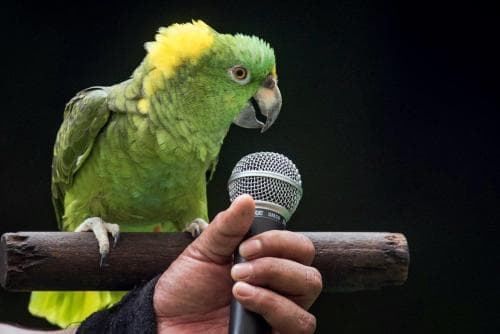
Few things about sharing your home with a parrot are as delightful as the moment your bird looks straight at you and says your name. Speech is one of the most enchanting things these animals do, and it is real communication far more often than people assume. But talking is not a trick you install by rote. It grows out of intelligence, trust, and a bird that genuinely wants to be part of your conversations. At Bird Sitting Toronto, where we care for hundreds of parrots every year, the birds that chatter most are almost always the ones who feel like full members of the household. This guide will help you build that same foundation with your own bird.
Can Every Parrot Learn to Talk?
The honest answer is no, and the honest expectation is that even gifted species may stay silent. Speech is mimicry, and a parrot's willingness and physical aptitude for it vary enormously by species, by individual, and often by sex. Some of the best-known talkers hold genuinely remarkable records: a budgerigar holds the Guinness World Record for the largest vocabulary of any bird, and the African grey Alex, studied for decades by Dr. Irene Pepperberg, used well over 100 labels in context to identify colours, shapes, and quantities.
Use the table below as a realistic guide to potential, not a guarantee.
| Species | Talking potential | Notes |
|---|---|---|
| African grey | Very high | Clear speech, large vocabularies, strong contextual use |
| Amazon parrots | Very high | Loud, expressive, often "sing" as well as talk |
| Budgerigar (budgie) | High | Big vocabularies possible, but a soft, mumbly voice; males mimic more readily |
| Indian ringneck | High | Crisp, clear diction |
| Quaker / monk parakeet | High | Excellent talkers for their small size |
| Eclectus | Moderate to high | Can be surprisingly clear talkers |
| Cockatoo | Variable | More known for sound and mood than for words |
| Macaw | Low to moderate | A handful of loud, gravelly words is typical |
| Conure | Low | Loud, playful, usually only a few words |
| Cockatiel | Low for words | Males excel at whistling tunes rather than speech |
| Lovebird | Very low | Rarely mimic human words |
Warning: Never choose a bird for its talking ability alone. A parrot is a decades-long commitment with loud calls, a serious mess, and demanding social needs whether or not it ever says a word. If your cockatiel only ever whistles the theme it invented, that is a completely successful, happy bird.
Why Your Bird Talks: Motivation Comes First
Wild parrots are intensely social flock animals, and vocal contact is how they stay connected to the flock. In your home, you are the flock. That single fact explains most of what works and what fails in speech training. Your bird learns to talk because words earn the thing it wants most from you: your attention, your voice back, your presence.
This is why the reward that matters is social, not edible. Praise, an excited response, and a bit of interaction do far more than a seed ever will. It also means a stressed, lonely, or frightened bird will not talk, no matter how many sessions you run. A calm, confident bird that feels bonded to you is the one that experiments with sound. If your bird seems tense or withdrawn, work on that first; our guide to reducing stress is the right place to start.
Setting Up Effective Training Sessions
Consistent, low-pressure repetition beats marathon drilling every time. A few principles make sessions productive:
- Speak clearly and repeat the same word or phrase many times, always the same way.
- Train in a quiet room free of distractions, with the television and other pets out of the picture.
- Take advantage of early morning and around sunset, when parrots are naturally most vocal.
- Keep sessions short: roughly 15 to 20 minutes, twice a day, is plenty.
- Bring genuine emotion and enthusiasm; birds tune in to an animated, upbeat voice.
- Reward every attempt with praise and warm attention, which is the single best reinforcement.
Tip: Reward approximations, not just perfection. The first time your bird makes any sound in the neighbourhood of "hello," respond with delight. Shaping rough attempts into clear words is exactly how vocabularies grow.
Keeping an eye on your bird's overall wellbeing during this routine matters too, since a bird that goes quiet or off its food may be unwell rather than simply uninterested. Our guide to recognizing when your bird is sick will help you tell the difference.
Teach Words in Context
Parrots learn language far faster when it is tied to real life rather than drilled in isolation. Pair words with the moments they describe, and the meaning comes along for free:
- Say "good morning" every time you uncover the cage, and "night night" when you cover it.
- Announce actions as they happen: "shower," "up," "step up," "breakfast," "bye bye" as you leave.
- Use consistent names for every person and pet in the household so your bird can attach a label to a face.
Do this steadily and many birds begin using the words at the right moments, greeting you when you walk in or asking to come "up." That is the difference between a parrot parroting and a parrot communicating.
The Model/Rival Method
The most powerful technique for context-rich learning is the model/rival method, developed by Dr. Irene Pepperberg in her landmark work with Alex the African grey. It works because it turns learning into the social competition parrots naturally care about.
In the classic version, two people and the bird sit together. One person is the trainer; the second is both a model of the right answer and a rival for the trainer's attention. The trainer holds up an object and asks, "What's this?" The human model answers correctly, is praised, and gets to handle the object. The bird watches another flock member earn attention and the prize, and is motivated to compete for the same reward. Roles are then swapped so the bird sees that anyone can play either part.
If you live alone, you can run a simplified solo version. Talk your bird through the same object naming with exaggerated enthusiasm, answer your own questions out loud, and lavish praise on the correct answer as though a rival had earned it. It is less potent than the two-person setup, but it keeps the crucial ingredients: real objects, real context, and attention as the reward.
Pairing training with a stimulating environment helps too, since a bored bird is a quiet bird. Our guide to building an engaging foraging experience will keep your parrot's mind busy between sessions.
Tools, Apps, and Realistic Expectations
Plenty of products promise to teach your bird to talk, from recording devices to phone apps that loop a phrase for hours. These can help reinforce a word between your own sessions, but they are no substitute for you. Speech is a social behaviour, and a recording cannot praise your bird or compete for its attention the way a living flock member can. Left running unattended, looping audio can also become a source of stress rather than learning, so use it briefly and watch how your bird responds.
Above all, hold your expectations loosely. Some brilliant, deeply bonded birds simply never talk, and they are no less intelligent or affectionate for it. Learning to read your bird's own signals, its body language, its contact calls, the whistles and sounds it invents, is every bit as rewarding as teaching a phrase. And whatever you are practising, keep sessions safe and calm; if anything ever goes wrong, our guide to first aid for birds will help you stay ready.
Explore related topics
Related Articles
Do Parrots Understand What They Say? The Science Is Surprising
Is your parrot just mimicking or do they actually understand? The research says it's more complex than simple mimicry.
How to Stop My Parrot from Screaming: A Step-by-Step Plan
Your parrot's screaming is driving you crazy. This structured plan addresses the root cause, not just the symptom.
Teaching Your Parrot to Whistle Tunes: A Fun Training Guide
Cockatiels are famous for it, but many species can learn tunes. Here's how to teach your bird to whistle your favorite song.