Encouraging Play: A Key to a Happy, Healthy Parrot
Play Is Preventive Medicine, Not a Luxury
If you have ever watched a wild parrot flock, you have seen birds that are almost never still. They forage for hours, dismantle bark and seed pods, climb, chew, and problem-solve their way through a full day. A companion parrot in your Toronto living room carries every one of those instincts—but a clean cage and a full food bowl remove nearly all the work those instincts were built for. That mismatch is where trouble begins.
Avian veterinarians consistently identify boredom and under-stimulation as a leading driver of behavioral problems in captive parrots. The Association of Avian Veterinarians (AAV) and clinical references such as the Merck Veterinary Manual and VCA Animal Hospitals all point to environmental enrichment as a first-line strategy for preventing—and helping to reverse—problems like feather-destructive behavior, chronic screaming, and biting. A bird with nothing to do will invent a job, and the jobs parrots invent for themselves are rarely ones you will enjoy.
That is why, at Bird Sitting Toronto, where we board hundreds of birds every year, we treat play as seriously as diet. A well-fed parrot with nothing to chew, shred, or solve is only half cared for.
Tip: Think of enrichment as a daily need on par with food and water, not an occasional gift. A parrot's brain is built to work for its living; give it work, and most "bad behaviors" quietly lose their fuel.
The Value of Independent Play
To help prevent dependency issues later in life, it is essential to encourage independent play in young birds. Parrots introduced early to a variety of safe toys—with different textures, colours, and shapes—tend to grow into more confident, curious, and self-sufficient adults who can entertain themselves when you step out of the room.
Many adult parrots who "don't play with toys" were simply never given the chance to explore diverse environments during their formative months. A bird that has learned to occupy itself is far less likely to develop the behavioral issues—feather plucking, screaming, or biting—that so often trace back to under-stimulation and over-reliance on human attention.
Why Play Works: Four Kinds of Enrichment
Fostering play is nearly as important as providing proper nutrition, and a good enrichment routine feeds four different needs at once:
- Physical health: Climbing, hanging, flapping, and wrestling with toys deliver the exercise a cage cannot.
- Emotional well-being: Novelty and problem-solving keep an intelligent mind occupied and lower stress.
- Instinctual fulfillment: Chewing, foraging, and manipulating objects satisfy hard-wired drives that would otherwise be aimed at feathers, furniture, or you.
- Social development: Interactive play strengthens your bond and builds a confident, trusting bird.
Matching Toys to the Job
Different toy styles deliver different benefits. A well-rounded parrot has a few of each in rotation rather than five versions of the same thing.
| Toy type | What it delivers | Good starter examples |
|---|---|---|
| Shreddable / destructible | Chewing outlet, instinctual "work" | Palm strips, vine balls, plain paper, cardboard |
| Foraging | Mental problem-solving, slows eating | Treat-stuffed puzzles, wrapped almonds, foraging wheels |
| Wood / hard-chew | Beak conditioning, durability | Balsa, pine slats, softwood blocks |
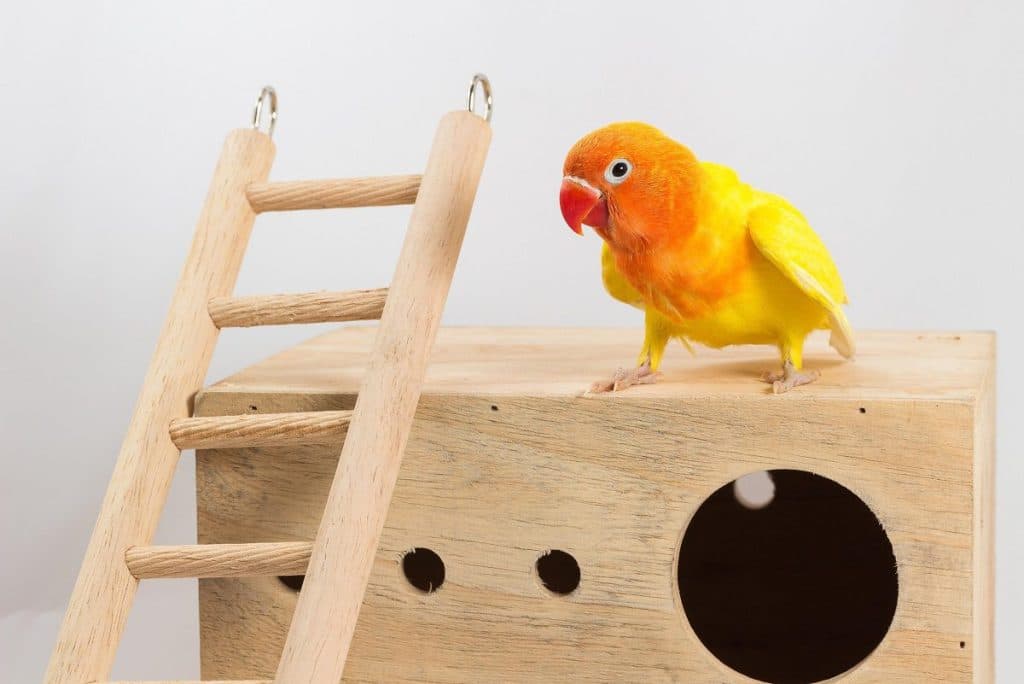
| Physical / movement | Exercise, balance, coordination | Swings, ladders, rope perches, boings |
| Foot / manipulation toys | Dexterity, independent solo play | Small blocks, safe beads, foot-held chew bits |
Can Older Birds Learn to Play? Absolutely.
Do not be discouraged if your bird ignores the first few toys. Birds, like people, have different interests and personalities, and a rescue or previously neglected parrot may be genuinely frightened of anything new. The answer is not to give up—it is to go slower.
For a wary bird, introduce toys through gradual desensitization rather than dropping a strange object into the cage:
- Set it nearby, outside the cage. Place the new toy on a table a few feet away where your bird can see it but does not have to interact. Leave it there for a day or two until it stops being alarming.
- Move it to the cage exterior. Clip or set the toy on the outside of the bars so it becomes part of the familiar landscape.
- Bring it just inside. Hang it near a food or water station your bird already visits, so curiosity does the rest.
- Make it rewarding. Tuck a favourite treat into or beside the toy so the first contact pays off.
Model the behaviour yourself, too—parrots are intensely social and often want whatever their human is enjoying. Roll a block across the table, "chew" on a piece of palm, and act delighted. That curiosity is contagious.
Tip: Start scared birds on soft, easily destructible materials like paper and palm. A toy that yields and shreds on the first bite gives an instant "I did that!" reward and builds confidence far faster than a hard wooden block.
Keep Every Toy Safe
Enrichment only helps if it cannot hurt your bird. A few safety habits prevent the most common toy-related injuries:
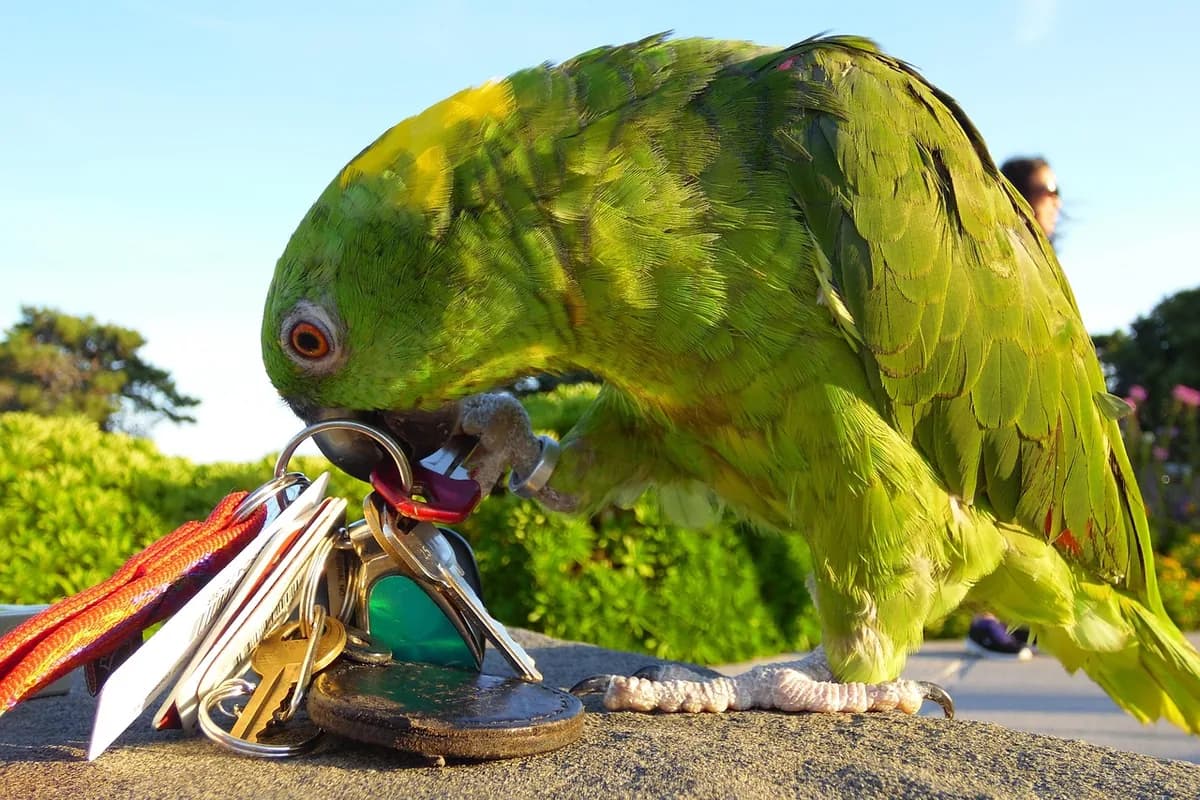
- Watch the metal. Cheap or unlabelled metal parts, clasps, and chains can contain zinc or lead, both of which are toxic to parrots and a recognized cause of heavy-metal poisoning in avian medicine. Choose stainless steel or nickel-plated hardware from reputable bird-toy makers, and skip galvanized quick-links.
- Prevent entanglement. Frayed cotton or sisal rope can wrap around a toe, wing, or neck. Trim loose threads regularly and retire any rope toy that has unravelled into a tangle.
- Size the hardware to the bird. Open bell clappers, split key-ring clasps, and gaps between links can trap toenails and beaks. Larger birds also need sturdier attachment points so a determined chewer cannot swallow a broken-off piece.
- Inspect and rotate. Check toys for sharp edges and swallowable fragments during cleaning, and rotate a few toys in and out each week to keep things novel without overwhelming the cage.
Warning: Never leave a bird unsupervised with a toy that is coming apart into small, swallowable pieces, and avoid unlabelled metal hardware entirely. Zinc and lead toxicosis can be fatal, and the early signs—vomiting, lethargy, unusual droppings—are easy to miss until a bird is seriously ill. When in doubt, remove the toy and call your avian vet.
Play Makes Boarding Easier, Too
When your parrot comes to stay with us, familiar toys are one of the simplest things you can pack. A favourite shredder or foraging puzzle from home carries a reassuring scent and gives your bird its normal "work" to do in a new place—one of the easiest ways to lower the stress of any stay away from home.
Remember, play is far more than entertainment. It is a cornerstone of your bird's overall wellness—a daily investment that keeps the body exercised, the mind engaged, and the feathers where they belong.
Explore related topics
Related Articles
Safe Toys for Happy, Healthy Parrots
The right toys keep a parrot's beak, feet, and mind healthy — the wrong ones cause choking, foot injuries, or heavy-metal poisoning. Here is how to choose bird-safe materials, match toy size to your species, build foraging into daily play, and run a simple safety routine.
Creating Safe Play Spaces for Your Parrot
A well-planned out-of-cage play area lets your parrot climb, forage, and join the family safely. Here is how to choose the right play stand, pick non-toxic woods and metals, bird-proof the room against fans, glass, open water, and kitchen fumes, and supervise the way a pro would.
Fun and Interactive Games to Play with Your Parrot
Play is how parrots bond, burn energy, and stay mentally sharp. Here are the interactive games we love most, plus how to read your bird's body language before you start, foraging and trick-training ideas, and the safety rules that keep playtime fun.