Reward-Based Training Techniques for Parrots
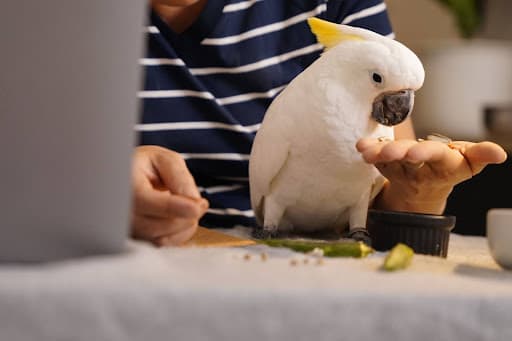
Reward-based training, more formally called positive reinforcement, is the method avian behaviour professionals and the Association of Avian Veterinarians (AAV) recommend above all others. The idea is simple: when your parrot does something you like and immediately gets something it wants, it will offer that behaviour more often. No fear, no force, no "dominance"—just a bird choosing to work with you because working with you pays.
At Bird Sitting Toronto, where we board hundreds of birds every year, the calmest, most confident guests are almost always the ones whose owners train this way. Here is how to do it well.
How Positive Reinforcement Actually Works
Every trained behaviour follows the same three-part loop:
- Cue — a word, hand signal, or presented target that tells your bird what you want.
- Behaviour — your parrot performs the action (steps up, turns around, touches the target).
- Reward — a small, high-value treat delivered instantly.
The word "instantly" is doing a lot of work. Parrots link a reward to whatever they were doing in roughly the last second. Reward two seconds late and you may accidentally reinforce the head-turn or the beak-lunge that came after the behaviour you actually wanted. Timing, not the size of the treat, is what makes training stick.
Tip: Say the cue once, then wait. Repeating "step up, step up, step up" teaches your bird that the cue means nothing until the third try. Cue, pause, and give your parrot a moment to think.
Charging a Bridge or Clicker
Because you often cannot get a treat into your bird's beak within one second, professional trainers use a bridge—a marker that says "yes, that, a treat is coming." A clicker is the classic tool, but a consistent word such as "good" works just as well and is always in your pocket.
Before the bridge means anything, you have to "charge" it: click, then immediately give a treat, and repeat 15 to 20 times over a few short sessions. Once your parrot perks up at the sound in anticipation of food, the bridge has become a promise you can deliver from across the room while a treat catches up.
Target Training: The First Skill to Teach
Target training—teaching your bird to touch a stick (or a chopstick) with its beak—is the foundation most trainers start with, and for good reason. It is easy, low-pressure, and it becomes the tool you use to teach almost everything else: stepping up, turning around, going into a carrier, moving between perches.
- Hold the target a beak's width from your bird's face.
- The instant the beak touches it, bridge ("good" or click) and reward.
- Move the target slightly farther each rep so your parrot follows it.
This is also your gentle introduction to shaping—rewarding small steps toward a goal rather than waiting for the finished trick. Want your bird to wave? First reward a lifted foot, then a higher lift, then the full wave. Break every behaviour into pieces small enough that your parrot can succeed on nearly every try.
Choosing the Right Reward
The best training treat is small, fast to eat, and something your bird only gets during sessions. This is where a healthy everyday diet becomes your ally. For most parrots the daily diet should be about 75 to 80 percent pellets and 20 to 25 percent fresh vegetable-forward foods, with seeds and nuts kept to roughly 5 percent as treats. That 5 percent is exactly your training currency: a single sunflower seed, a slice of almond, a pine nut, or a scrap of millet carries enormous value precisely because your bird never sees it at the food bowl.
| Reward tier | Examples | Best used for |
|---|---|---|
| High value | Sunflower seed, almond piece, pine nut, safflower seed | New or difficult behaviours; recall |
| Medium value | Millet spray, small berry, cooked corn kernel | Steady practice of known behaviours |
| Low value / praise | A favourite pellet, warm verbal praise, head scratch | Easy repetitions, cool-downs |
Warning: Never starve or food-deprive a bird to make it "more motivated." That is stressful, damaging to trust, and unnecessary. Motivation comes from the value and exclusivity of the treat, not from hunger. Train before a meal when your parrot is keen, not when it is desperate.
Setting Up a Great Session
A little structure makes every session more productive.
- Keep it short. Aim for 5 to 15 minutes, and always stop while your bird still wants more. Long sessions produce diminishing returns and frustration.
- Train daily. Frequent short sessions beat rare marathons for building lasting habits.
- Use a neutral space. A T-stand or training perch in a quiet room, away from the cage and household traffic, helps your bird focus.
- One behaviour at a time. Master a single skill before layering on the next.
- End on a win. Finish with a behaviour your parrot knows well, bridge, jackpot with an extra treat, and let it go do something fun.
Reading Your Bird: When to Stop
Training only works when your parrot is a willing participant. Watch its body language and respect it. Pushing through the signals below is the fastest way to teach a bird that the training perch is a place of stress.
| Keep going | Take a break |
|---|---|
| Leaning in, eager, taking treats readily | Turning away, ignoring the treat |
| Relaxed, smooth feathers | Feathers slicked tight or fluffed and hunched |
| Bright, "pinning" eyes with interest | Rapid pinning with a raised beak (agitation) |
| Offering behaviours enthusiastically | Backing up, wiping beak, trying to leave |
If your bird disengages, that is information, not disobedience. End the session calmly and try again later.
Troubleshooting Common Snags
- My bird bites or lunges. Do not reward it (even scolding is attention). Ask for an easier behaviour it can succeed at, and look at what came just before the bite—usually the ask was too hard, too fast, or too close.
- It only performs for one person. Have every willing family member run identical sessions with the same cues and the same high-value treats so your parrot generalizes the behaviour to more people.
- We have hit a plateau. Break the behaviour into smaller steps, raise the treat value temporarily, or shorten sessions. Plateaus almost always mean a step was too big.
- My bird loses interest fast. Shorten the session, train before a meal, and confirm your treat is genuinely exclusive.
The Bigger Payoff
Reward-based training is about far more than tricks. The bird cognition research of Dr. Irene Pepperberg with the African grey Alex showed just how much these animals can learn and reason when taught with patience and positive methods. Every session you run builds trust, provides mental enrichment, and gives you a low-stress way to ask for practical behaviours—stepping onto a hand, entering a carrier, or accepting a nail check.
With good timing, the right treat, and respect for your bird's signals, treat-based training turns everyday interactions into a genuine partnership—and a calmer, more confident companion, whether your parrot is at home with you or boarding with us.
Explore related topics
Related Articles
Clicker Training for Parrots: The Complete Beginner's Guide
Clicker training is the most effective way to communicate with your parrot. Here's how to start from zero.
Crate Training Your Parrot: Stress-Free Vet Visits and Travel
The travel carrier doesn't have to be terrifying. Crate training makes vet visits and travel manageable.

Desensitization Training: Helping Fearful Parrots Overcome Their Fears
New toys, strangers, vet visits — many parrots are terrified. Systematic desensitization changes that safely.