Positive Reinforcement Training for Parrots: Building Trust, Confidence, and Cooperation
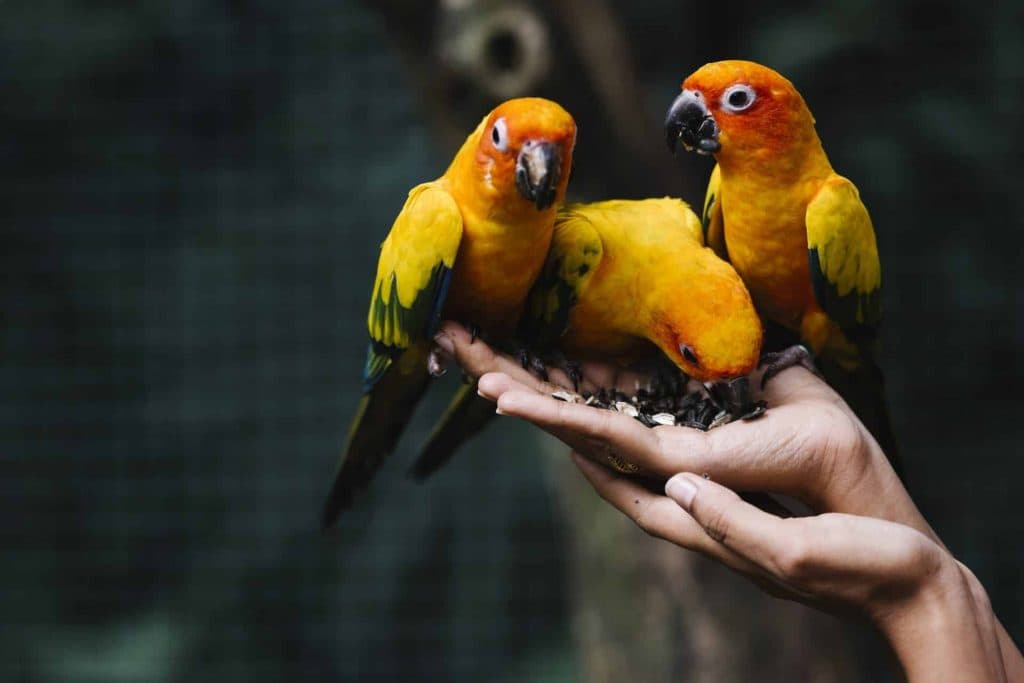
When most people picture parrot training, they imagine a bird performing tricks on cue. Positive reinforcement goes far beyond entertainment. It is a science-based way of communicating that helps you build trust, resolve real behavior problems, and improve your parrot's quality of life. At Bird Sitting Toronto, where we board hundreds of birds every year, the calmest, most confident guests are almost always the ones whose owners taught them that cooperation pays off. This guide walks you through exactly how that works.
What Positive Reinforcement Actually Is
Positive reinforcement means adding something your parrot values immediately after a behavior you want, which makes that behavior more likely to happen again. It sits inside applied behavior analysis (ABA), the same well-established science of learning used with zoo and companion animals worldwide.
The key contrast is with punishment and negative reinforcement, which rely on fear, force, or discomfort. Grabbing a bird, shouting "no," squirting water, or dropping the perch to force a step-up can all suppress a behavior in the moment, but they teach your parrot that your hands and your presence predict bad things. That erodes trust and often creates the very biting and fear you were trying to fix. Positive reinforcement moves in the opposite direction: it gives your bird a reason to want to participate.
Trained this way, parrots reliably learn practical, welfare-improving skills:
- Stepping up and stepping down calmly on cue
- Walking into a travel carrier on their own
- Cooperating with nail, beak, and wing checks without being restrained
- Stationing on a scale so you can track weight
- Playing with toys and foraging instead of screaming or plucking
Even "just for fun" behaviors like waving, turning around, or retrieving an object are valuable, because they build a shared vocabulary and give your bird a job to do. Research on parrot cognition, including Dr. Irene Pepperberg's decades of work with the African grey Alex, shows just how much these birds can learn when learning is rewarding rather than coerced.
The Core Loop: Cue, Bridge, Reward
Nearly every positive-reinforcement session runs on the same three-part loop. Learn it once and you can teach almost anything.
| Element | What it is | Example |
|---|---|---|
| Cue | A clear, consistent signal that tells your bird which behavior earns a reward | The words "step up," a flat finger presented at chest height |
| Bridge | A marker that pinpoints the exact instant your bird did the right thing | A clicker, or a short, upbeat "good!" |
| Reward | Something your bird genuinely values, delivered right after the bridge | A single sunflower seed, a sliver of almond, a favorite millet piece |
The bridge is the part people skip, and it matters more than it looks. Your parrot is fast, and a reward that arrives two seconds late can accidentally reinforce the wrong thing (a lean-away, a beak-open). The bridge freezes the correct moment so the reward that follows is unambiguous. Charge the bridge first: click or say "good," then immediately hand over a treat, ten or fifteen times, until your bird's eyes light up at the sound alone. Now it means something.
Tip: Keep treats tiny. A single sunflower seed or a rice-grain-sized piece of nut is plenty. Small rewards mean more repetitions per session before your bird is full, and faster progress. Seeds and nuts are treats, not meals: they belong in the roughly 5% of the diet reserved for treats, on top of a foundation of about 75 to 80% quality pellets and 20 to 25% fresh, veg-forward foods.
Shaping: Building Behaviors in Approximations
You almost never get the finished behavior in one go. Instead you reward successive approximations — small steps that move steadily toward the goal. Each time your bird masters one step, you raise the bar slightly and reward the next.
Take teaching a parrot to enter a travel carrier, a skill that transforms both vet trips and boarding drop-offs:
- Reward any calm look toward the carrier.
- Reward a step in its direction.
- Reward touching or leaning into the opening.
- Reward putting the head inside.
- Reward one foot in, then two, then a full, relaxed entry.
You might cover the first three steps in a single five-minute session and spend three days on the last two. That is normal. The same laddered approach teaches a retrieve — lure the bird to pick up a small object, then shape dropping it into a bowl, rewarding each stage — or a voluntary scale station, or holding still for a wing to be gently extended.
Warning: Never withhold your parrot's staple diet to create hunger as leverage. Training motivation comes from preferred foods offered in addition to a complete daily diet, not from an underfed bird. Starving a parrot into compliance is a welfare problem and can mask illness, since appetite loss is often the first sign a bird is sick. Train before a normal meal when your bird is a little food-motivated, not by rationing what it needs to stay healthy.
Setting Up for Success
- Keep sessions short. Three to five minutes, once or twice a day, beats a single long drill. Parrots learn in the early minutes and check out after that.
- Train at eye level or below. Looming over a bird from above is intimidating. Working at chest height, or with the bird slightly below your eyeline, lowers the pressure.
- End on a win. Stop while your bird is still succeeding and interested, not after a failure. The last rep is the one it remembers.
- Read the body language. Pinned eyes, a raised foot, feathers slicked tight, or leaning away all mean "too much, too fast." Back up to an easier approximation and rebuild.
- Be boringly consistent. Use the same cue word and the same hand position every time. Changing "up," "step up," and "come here" from day to day just muddies the signal.
Common Mistakes That Erode Trust
Even well-meaning owners can accidentally teach the wrong lesson:
- Punishing a bite. Yelling or dropping the bird after a bite usually backfires. Biting is communication — often "I'm scared" or "please stop." Watch for the warning signs, avoid the trigger, and reward calm behavior before the bite happens.
- Rewarding screaming. Running over, talking, or even scolding when a parrot screams gives it exactly what it wanted: your attention. Ignore the demand screaming and reward the quiet moments and normal contact calls instead.
- Inconsistent cues and rewards. If a behavior pays off some days and not others, or the cue keeps changing, your bird learns that the game has no rules and stops trying.
- Moving too fast. Skipping approximations to "get to the good part" is the number-one reason training stalls. When in doubt, split the step into two smaller ones.
Final Thoughts
Positive reinforcement is not a bag of party tricks — it is a language of trust. When your parrot learns that its choices produce good outcomes, everyday tasks like stepping up, going into a carrier, or holding still for a nail trim stop being battles and become things it willingly offers. That is better for its welfare and far easier on you. Go slowly, reward generously with the right-sized treats, and celebrate small wins. If you are working through a persistent problem like severe biting, screaming, or feather-destructive behavior, avian veterinary consensus is to first rule out pain or illness with an avian veterinarian, then partner with a qualified positive-reinforcement trainer. Your bird is always learning something from you. This is how you make sure it is learning the right thing.
Explore related topics
Related Articles
Clicker Training for Parrots: The Complete Beginner's Guide
Clicker training is the most effective way to communicate with your parrot. Here's how to start from zero.
Crate Training Your Parrot: Stress-Free Vet Visits and Travel
The travel carrier doesn't have to be terrifying. Crate training makes vet visits and travel manageable.
Desensitization Training: Helping Fearful Parrots Overcome Their Fears
New toys, strangers, vet visits — many parrots are terrified. Systematic desensitization changes that safely.